Tuesday, January 30, 2007

Good Food

These are really good foods for people who have Gout because they are purine rich.

Organ meats such as liver, kidney, heart, brain, etc.
Selected fish and shellfish ie. ikan bilis, sardines, mackerel (including selar, tenggiri & kembong), herring, salmon, fish roe, cockles and mussels
Meat & yeast extracts such as Bovril, Marmite, Vegemite, essence of chicken, brewer's and baker's yeast
Meat soups & stock cubes especially Bak Kut Teh
Game meat ie. venison, black chicken, pigeon, goose, etc.
Beans & lentils such as tofu, soya bean, bean fillings, etc.
Selected vegetables ie. spinach, rhubarb, asparagus, cauliflower, mushrooms & peas
Strawberry, strawberry jam, durian, tomato & tomato products


Monday, January 29, 2007

The 4 stages of Gout

Asymptomatic (without symptoms) hyperuricemia--In this stage, a person has elevated levels of uric acid in the blood but no other symptoms. A person in this stage does not usually require treatment.

Acute gout, or acute gouty arthritis--In this stage, hyperuricemia has caused the deposit of uric acid crystals in joint spaces. This leads to a sudden onset of intense pain and swelling in the joints, which also may be warm and very tender. An acute attack commonly occurs at night and can be triggered by stressful events, alcohol or drugs, or the presence of another illness. Early attacks usually subside within 3 to 10 days, even without treatment, and the next attack may not occur for months or even years. Over time, however, attacks can last longer and occur more frequently.


Interval or intercritical gout--This is the period between acute attacks. In this stage, a person does not have any symptoms and has normal joint function.


Chronic tophaceous gout--This is the most disabling stage of gout and usually develops over a long period, such as 10 years. In this stage, the disease has caused permanent damage to the affected joints and sometimes to the kidneys. With proper treatment, most people with gout do not progress to this advanced stage.

Thursday, January 25, 2007

Signs and symptoms of gout


The classic picture is of excruciating and sudden pain, swelling, redness, warmness and stiffness in the joint. Low-grade fever may also be present. The patient usually suffers from two sources of pain. The crystals inside the joint cause intense pain whenever the affected area is moved. The inflammation of the tissues around the joint also causes the skin to be swollen, tender and sore if it is even slightly touched. For example, a blanket draping over the affected area could cause extreme pain.

Gout usually attacks the big toe (approximately 75% of first attacks), however it can also affect other joints such as the ankle, heel, instep, knee, wrist, elbow, fingers, and spine. In some cases the condition may appear in the joints of the small toes which have become immobile due to impact injury earlier in life, causing poor blood circulation that leads to gout.
Patients with longstanding hyperuricemia (see below) can have uric acid crystal deposits called tophi (singular: tophus) in other tissues e.g. the helix of the ear. Uric acid stones can form as one kind of kidney stone in some occasions.

Wednesday, January 24, 2007

What causes gout?

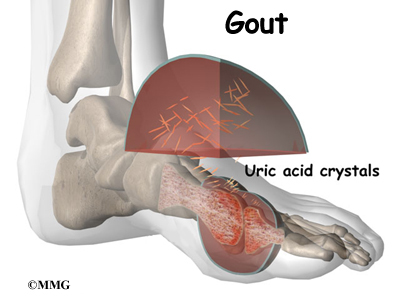
Gout is caused by a chemical in the blood called uric acid (urate). Uric acid is usually harmless, and is made in the body from certain foods. It is passed out with the urine. The amount of uric acid in the blood builds up in some people. From time to time the level may become too high. When the level of uric acid becomes high tiny grit-like crystals of uric acid may form.

The crystals typically collect in a joint. This causes inflammation, swelling, and pain - a gout attack.
Note: some people have a high level of uric acid but do not form crystals or have gout. Also, rarely, some people with a normal level of uric acid have gout attacks. However, as a rule, the higher the level of uric acid, the greater the chance of forming crystals and developing gout.
In most cases there is no apparent reason for the build up of uric acid. In some people, the build up of uric acid may have a known cause.

If you drink too much alcohol it can cause uric acid to build up.
Some medicines such as diuretics ('water tablets'), low dose aspirin, and some used as chemotherapy for cancer may raise the level of uric acid.
More uric acid is made than usual in illnesses where the cells of the body have a rapid turnover.

For example, severe psoriasis and some blood disorders.
Certain foods may 'tip the balance' to raise your uric acid higher than normal. In particular, eating heart, herring, sardines, or mussels frequently may increase the level of uric acid. However, eating a normal balanced diet should not have much effect on the uric acid level.

Monday, January 22, 2007

Waning Signs

HOW COMMON IS GOUT?
Gout affects close to one in 30 North Americans. Men are at least four times more likely to develop gout than women. Gout occurs more frequently in countries that have a high standard of living. Men who develop gout usually do so between the ages of 40 and 50. Women are more likely to develop gout after the age of 60.

WHAT ARE THE WARNING SIGNS OF GOUT?
Intense, continuous pain in a joint, usually the big toe.
Hot, red, swollen skin and a feeling of pressure around the painful area. This may be accompanied by a stretching or tearing sensation in the skin.

Thursday, January 18, 2007

Gout

Acute symptoms of gout (flare-ups) seem to happen more frequently under certain conditions. These include:
Having an infection
Having sustained a joint injury
Having surgery or being hospitalized
Overindulgence in alcohol or purine-rich foods
Being stressed
Being dehydrated

Wednesday, January 17, 2007

Gout and Hyperuricemia

In most cases, gout is associated with a condition known as hyperuricemia. Hyperuricemia occurs when the blood contains raised levels of uric acid sustained over long periods. The kidneys process uric acid and excrete this through urine. When uric acid levels become raised, the kidneys are unable to eliminate uric acid efficiently. In some cases, the cause of gout is not linked to hyperuricemia but to kidney disease. Blood uric acid levels can arise when the kidney is not functioning properly. Whichever cause, the kidneys can become damaged when blood uric acid levels are raised over long periods.

The body unable to eliminate uric acid, deposits a hardened crystallised form of uric acid (tophi) usually in the joints and skin. Within the joints, deposits can be made in the joint fluid (synovial fluid) and joint lining (synovial lining).Common areas for these deposits are the ankles,
feet and ball of the large toe. Less common areas of uric acid deposits include the ears and eyes. Tophi, areas of hardened uric acid, may also be seen under the skin around the fingers and toes.

Monday, January 15, 2007

One of my main questions

As you have noticed from my other posts, I have become very interested in learning about gout and I've been doing plenty of research on it. This is the answer to one of my main questions: what are the causes of Gout?

What Causes Gout?
A number of risk factors are related to the development of hyperuricemia and gout:
Genetics may play a role in determining a person's risk, since up to 18 percent of people with gout have a family history of the disease.
Gender and age are related to the risk of developing gout; it is more common in men than in women and more common in adults than in children.
Being overweight increases the risk of developing hyperuricemia and gout because there is more tissue available for turnover or breakdown, which leads to excess uric acid production.
Drinking too much alcohol can lead to hyperuricemia because it interferes with the removal of uric acid from the body.
Eating too many foods rich in purines can cause or aggravate gout in some people.
An enzyme defect that interferes with the way the body breaks down purines causes gout in a small number of people, many of whom have a family history of gout.
Exposure to lead in the environment can cause gout.
Some people who take certain medicines or have certain conditions are at risk for having high levels of uric acid in their body fluids. For example, the following types of medicines can lead to hyperuricemia because they reduce the body's ability to remove uric acid:
Diuretics, which are taken to eliminate excess fluid from the body in conditions like hypertension, edema, and heart disease, and which decrease the amount of uric acid passed in the urine;
Salicylates, or anti-inflammatory medicines made from salicylic acid, such as aspirin;
The vitamin niacin, also called nicotinic acid;
Cyclosporine, a medicine used to suppress the body's immune system (the system that protects the body from infection and disease) and control the body's rejection of transplanted organs; and
Levodopa, a medicine used to support communication along nerve pathways in the treatment of Parkinson's disease.

Friday, January 12, 2007

Gout Risk Factors

OK, so I have written a lot about gout. You might be wondering, "can I get Gout?" Or 'what are my chances of getting Gout?' so, here I post some of the risk factors
WHAT ARE YOUR RISK FACTORS?

  • Genetic factors. Approximately one in four people with gout have a family history of the disease. In some families, the enzyme that helps the body break down purines is missing.
  • Consuming a steady diet of foods that are high in purines. (Foods that are high in purines break down in the body to uric acid.) Purine-rich foods include organ meats, herring, mackerel and trout (beans and peas also contain purines; however, at lower levels).
  • Eating to excess. Habitual heavy eaters often develop gout because large quantities of food increase the amount of uric acid produced by the body.
    Taking certain medications. Drugs that reduce the body’s ability to remove uric acid, such as diuretics (water pills), salicylates (ASA, Aspirin®), cyclosporine (Neoral®) and levodopa (Prolopa®) contribute towards the development of gout. Since the vitamin B3 (niacin) raises uric acid levels, it may also contribute toward the condition when used in excess.
  • Having certain degenerative conditions that give rise to excessive breakdown of cells. This can increase serum purine levels which in turn increase the amount of uric acid in the body.

Wednesday, January 10, 2007

WHAT ARE YOUR GOUT RISK FACTORS?

Genetic factors. Approximately one in four people with gout have a family history of the disease. In some families, the enzyme that helps the body break down purines is missing.
Consuming a steady diet of foods that are high in purines. (Foods that are high in purines break down in the body to uric acid.) Purine-rich foods include organ meats, herring, mackerel and trout (beans and peas also contain purines; however, at lower levels).
Eating to excess. Habitual heavy eaters often develop gout because large quantities of food increase the amount of uric acid produced by the body.
Taking certain medications. Drugs that reduce the body's ability to remove uric acid, such as diuretics (water pills), salicylates (ASA, Aspirin®), cyclosporine (Neoral®) and levodopa (Prolopa®) contribute towards the development of gout. Since the vitamin B3 (niacin) raises uric acid levels, it may also contribute toward the condition when used in excess.
Having certain degenerative conditions that give rise to excessive breakdown of cells. This can increase serum purine levels which in turn increase the amount of uric acid in the body.
Acute symptoms of gout (flare-ups) seem to happen more frequently under certain conditions. These include:
Having an infection
Having sustained a joint injury
Having surgery or being hospitalized
Overindulgence in alcohol or purine-rich foods
Being stressed
Being dehydrated

Monday, January 8, 2007

Tips to reduce gout

Avoid purine-rich foods. Purines are found in many animal products with the exception of low fat dairy goods and eggs. Organ meats (liver, heart, kidneys, sweetbreads), herring, mackerel, anchovies and trout are particularly rich sources. Broths and gravies are also to be avoided. (Beans and peas contan a moderate amount of purine and should be limited to 1-2 servings per day).
*Although a peanut is technically considered a legume, its purine content is relatively low (less than 50 mg per 100 grams) compared to other more common legumes such as lentils, peas & beans which has 50 - 150 mg purine per 100 grams
Control your weight but avoid crash diets and rapid weight loss which can give rise to acute flare-ups.
Increase your fluid intake. Drinking plenty of fluids helps to dilute uric acid in the urine. This helps prevent the formation of kidney stones made from uric acid. Drink 2 to 3 litres (8 to 12 cups) of fluid each day. Water, herbal teas, vegetable juice, milk, unsweetened fruit juices and soup all contribute to your daily fluid intake.
Limit alcohol and caffeine. Alcohol contains purines and also interferes with the body’s excretion of uric acid. Beer is particularly bad as it is rich in purines. Heavy drinking also increases body weight and blood triglycerides, two factors also implicated in the development of gout. Speak to your doctor about the use of alcohol. Moderate, drinking (one drink a day) is unlikely to increase your risk of a gout attack.
Consider vitamin B12. If you take the medication colchicine for gout, consider taking a vitamin B12 supplement, since this drug impairs the body’s ability to absorb B12. Vitamin B12 is found exclusively in animal foods such as meat, poultry, eggs, and dairy products. With the exception of eggs and dairy produce, these foods should be limited due to their purine content. Fortified soy and rice beverages also contain B12.
Consume black cherries. Recent studies have suggested that intake of black cherries may benefit people suffering from gout (the gout preventative qualities of cherries seem to be the result of plant compounds found in cherries called anthocyanins).
Add hemp seeds, pumpkin seeds and flax seeds to your diet; these foods contain health promoting omega 3 fatty acids, to reduce joint inflammation; these foods contain health promoting omega 3 fatty acids, to reduce joint inflammation. Increase your intake of fresh fruit and vegetables; cut down on foods rich in hydrogenated oils (trans fats), animal fats, particularly fatty meats (beef, pork) and high-fat dairy products.
Consult your doctor / healthcare professional about new food-based non-drug supplements formulated to help improve quality of life* such as Recovery with Nutricol®.
The following is a more complete list of purine rich foods:
Organ meats such as liver, kidney, heart, brain, etc.
Selected fish and shellfish ie. ikan bilis, sardines, mackerel (including selar, tenggiri & kembong), herring, salmon, fish roe, cockles and mussels
Meat & yeast extracts such as Bovril, Marmite, Vegemite, essence of chicken, brewer's and baker's yeast
Meat soups & stock cubes especially Bak Kut Teh
Game meat ie. venison, black chicken, pigeon, goose, etc.
Beans & lentils such as tofu, soya bean, bean fillings, etc.
Selected vegetables ie. spinach, rhubarb, asparagus, cauliflower, mushrooms & peas
Strawberry, strawberry jam, durian, tomato & tomato products

Thursday, January 4, 2007

drink milk, avoid seafood

If you want to prevent painful gout you should drink milk and dairy products. You should not, however, eat lots of red meat and seafood. This is according to a report in the New England Journal of Medicine. Beans, peas, mushrooms, spinach and cauliflower do not seem provoke gout, the researchers said. People used to think they did. If you eat an extra portion of beef, pork or lamb each day your risk of developing gout goes up by 21%.If you have an extra seafood meal a week you risk goes up by 7%. Strangely, this risk is most prevalent among men who are not overweight. If you drink one to five glasses of low-fat milk per day, your risk goes down by 43%

Wednesday, January 3, 2007

Big TOe

SOmeOne I knOw was experiencing pain in her big tOe> We didn't make much Of a big deal Out Of it, but later, she fOund Out that she had gOut> The dOctOr tOld her that for many people, gout initially affects the joints in the big toe and that sometime during the course of the disease, gout will affect the big toe in about 75 percent of patients. It also can affect the instep, ankles, heels, knees, wrists, fingers, and elbows.